Crawl Space Encapsulation · New Jersey
Crawl Space Encapsulation in New Jersey
A damp, vented crawl space feeds moisture, mold and cold floors into the rest of your home. RDC Waterproofing seals it off for good — a heavy vapor barrier over every surface, drainage and a sump for groundwater, a dehumidifier to hold the air dry, and sealed vents — backed by a lifetime transferable warranty.
- Free 7-day inspections
- Lifetime transferable warranty
- We fix the source, not upsell
- All 21 NJ counties
Musty, damp crawl space?
Tell us what you’re seeing — standing water, a smell rising through the floors, sagging insulation, or rotting wood — and we’ll diagnose it free.
Get My Free InspectionLifetime transferable dry-basement warranty · Licensed & insured NJ contractor
Quick answer
Crawl space encapsulation in New Jersey means sealing the entire crawl space — floor and walls — in a thick, reinforced vapor barrier, closing off outside vents, adding drainage and a sump pump for groundwater, and running a dehumidifier so the space stays permanently dry. It stops ground moisture, mold, musty odors and wood rot, cuts energy loss, and protects the structure above. RDC inspects free, seals the source of the moisture first, and warranties the work across New Jersey. Call (908) 569-1876.
Solutions
A complete, sealed crawl space — not a bag of quick fixes
For decades, New Jersey crawl spaces were built “vented” on the theory that outside air would dry them out. It does the opposite: in a humid NJ summer, warm outside air pours in, hits the cool ground and framing, and condenses. Combined with moisture wicking up through bare clay soil, that keeps the crawl space damp all season — and up to half the air you breathe upstairs comes from down there. Encapsulation reverses the whole idea by sealing the space instead of ventilating it.
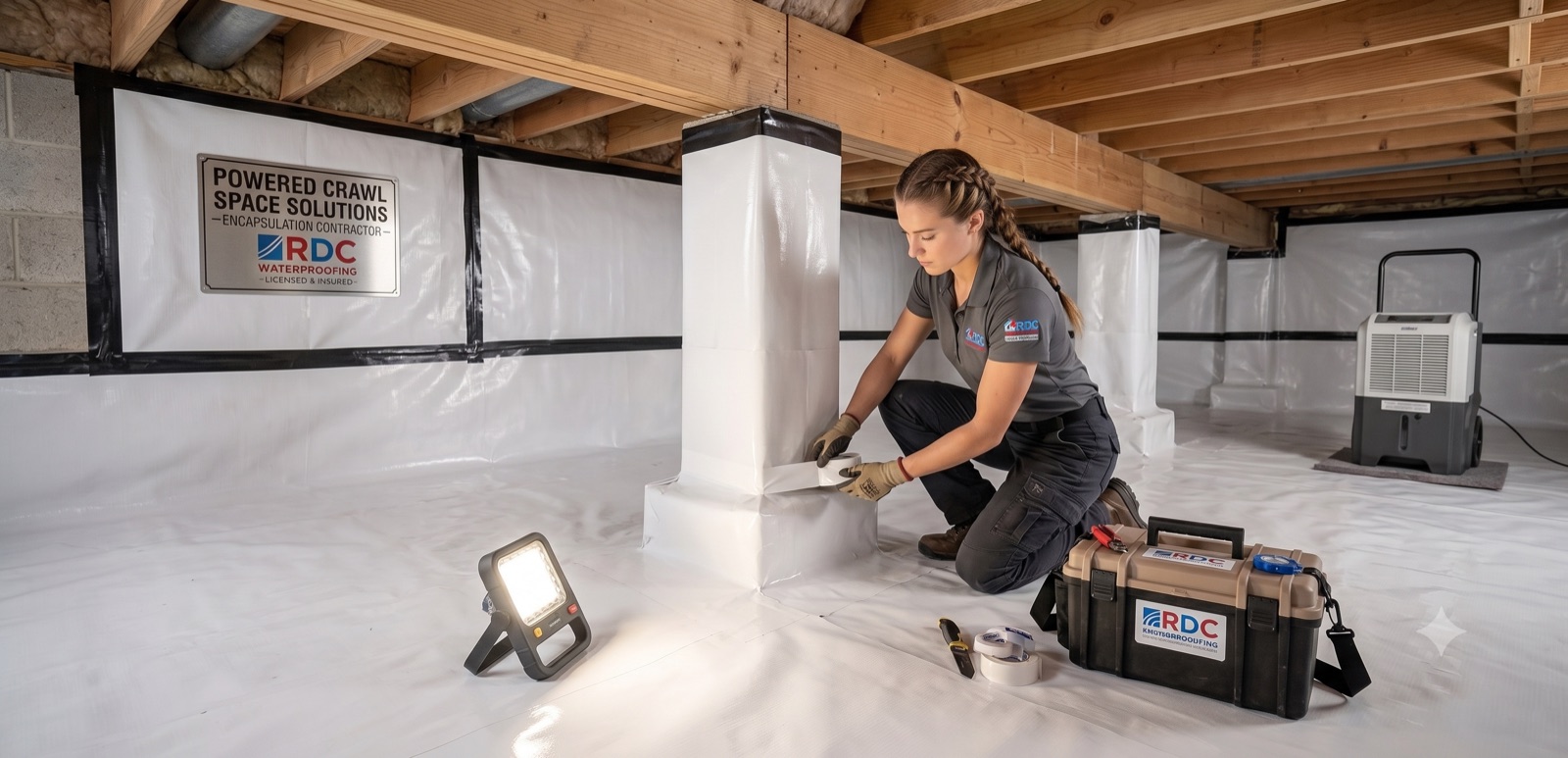
After a free inspection, RDC builds a complete system from these components:
- Sealed vapor barrier: a heavy, reinforced polyethylene liner — typically 12 to 20 mil — run across the floor and up the walls, seams overlapped and sealed, so no ground moisture gets through.
- Crawl space drainage & sump: a perimeter drain and a sump pump to capture and remove any groundwater that pushes up under the liner, so the barrier stays dry beneath.
- Dehumidification: an energy-efficient crawl-space dehumidifier that holds relative humidity below the level mold needs — the piece that keeps the sealed space dry year round.
- Sealed vents & access: closing and insulating the old foundation vents and sealing the access door so humid outside air can no longer get in.
- Insulation & rim-joist sealing: insulating the walls and sealing the rim joist to stop drafts and hold conditioned temperature.
Encapsulation and air quality go hand in hand. If you already smell mold or have a humidity problem upstairs, pair it with basement mold & humidity control. And if the crawl space piers or walls are settling, see foundation repair first.
Warning signs
Signs your New Jersey crawl space needs encapsulation
Any one of these means moisture is getting into your crawl space and rising into your home.
Musty smell in the house
A damp, earthy odor drifting up through the floors is crawl-space air — and the mold in it — being pulled upstairs.
Standing water or damp soil
Puddles, wet dirt, or a mud-slick liner after rain mean groundwater is entering and needs drainage, not just a barrier.
Sagging, wet insulation
Fiberglass batts that droop or fall from the floor joists are soaked with condensation — a classic vented-crawl failure.
Mold on framing & wood rot
White or black growth on joists and subfloor, or soft, spongy wood, means moisture is attacking the structure above.
Cold, bouncy floors
Floors that feel cold in winter or flex underfoot point to lost insulation value and weakening framing below.
High energy bills & humidity
A humid house and rising heating and cooling bills often trace to unconditioned air and moisture pouring up from the crawl space.
Causes
Why crawl spaces stay wet in New Jersey
New Jersey’s climate and soils are hard on a crawl space. Humid, muggy summers push moisture-laden air into any vented space, dense clay holds water against foundation walls, and a high water table pushes groundwater up through the dirt floor. Add nor’easters and spring thaws and the space rarely gets a chance to dry. Moisture gets in through four main paths:
- Ground evaporation: a bare soil floor releases gallons of water vapor a day straight into the crawl space.
- Open foundation vents: in summer, humid outside air enters through the vents, hits cool surfaces and condenses into liquid water.
- Groundwater intrusion: a high water table and saturated clay push water up through the floor and in at the footing after heavy rain.
- The stack effect: warm air rising through the house pulls crawl-space air — moisture, mold spores and odor — up into your living space.
Because a vapor barrier alone won’t hold if groundwater is still pushing up under it, diagnosis matters. RDC’s inspection reads your moisture source, water table and framing before recommending a system — and our reviewers regularly note we fixed the true cause instead of selling a liner that would have failed.
How it works
From free inspection to a sealed, dry crawl space
Free inspection
We measure humidity, check the framing, and find where water and vapor are entering — no pressure.
Fixed-price plan
You get an itemized, fixed-price quote for the exact encapsulation system your crawl space needs.
Clean installation
Our own crews install drainage, the sealed vapor barrier, dehumidifier and vent sealing cleanly and on schedule.
Lifetime warranty
You receive a written, lifetime transferable warranty — and a crawl space that stays dry and healthy.
Why RDC Waterproofing
The crawl space team New Jersey trusts to be straight with them
- 20+ years, 1,000+ 5-star reviews as the RDC brand New Jersey already knows.
- Honest diagnosis: reviewers repeatedly note we fixed the true cause and didn’t oversell.
- Lifetime transferable warranty that stays with the home when you sell.
- Our own crews — trained RDC technicians, not rotating subcontractors.
- Licensed, bonded & insured New Jersey contractor, BBB A-rated.
Led by founder Russell Calderone — 20+ years keeping New Jersey homes dry. Meet the team →
Where we work
Crawl space encapsulation across all 21 NJ counties
Tap your county for local crawl space and waterproofing service. See all service areas →
Crawl space encapsulation questions
Frequently asked questions
How much does crawl space encapsulation cost in New Jersey?
A basic vapor barrier for a small, dry crawl space starts in the low thousands; a full system with drainage, a sump pump, a dehumidifier and sealed vents for a larger or wetter space runs higher, depending on square footage and how much groundwater is present. RDC gives a fixed, itemized quote after a free inspection and recommends only what your crawl space needs.
Is crawl space encapsulation worth it?
For most NJ homes, yes. Sealing the crawl space stops mold and wood rot, removes the musty smell from your living space, improves indoor air, lowers humidity, and usually cuts heating and cooling bills because you’re no longer conditioning damp outside air. It also protects the structure and is a genuine selling point at resale.
Should crawl space vents be open or sealed?
Sealed. The old idea that vents dry a crawl space is backwards in New Jersey’s humid climate — open vents let warm, moist summer air in to condense on cool surfaces. Modern building science calls for sealing the vents and conditioning the space with a dehumidifier, which is exactly what encapsulation does.
Do I still need a dehumidifier after encapsulation?
Yes — it’s part of a complete system. The vapor barrier and sealed vents stop new moisture from entering, but a dedicated crawl-space dehumidifier holds the humidity low enough that mold can never take hold. See humidity control for how the two work together.
Can you encapsulate a crawl space that floods?
Yes, but the water has to be managed first. We install perimeter drainage and a sump pump to remove groundwater, then seal the space over top. Sealing a flooding crawl space with just a liner and no drainage traps water underneath — which is why our inspection always checks the water source first.
Which parts of New Jersey do you serve?
All 21 NJ counties, from hubs in Berkeley Heights and Piscataway. Find your county on our service areas page.
Get your crawl space inspected free
Honest diagnosis, a fixed-price quote, and a lifetime transferable warranty — anywhere in New Jersey.